
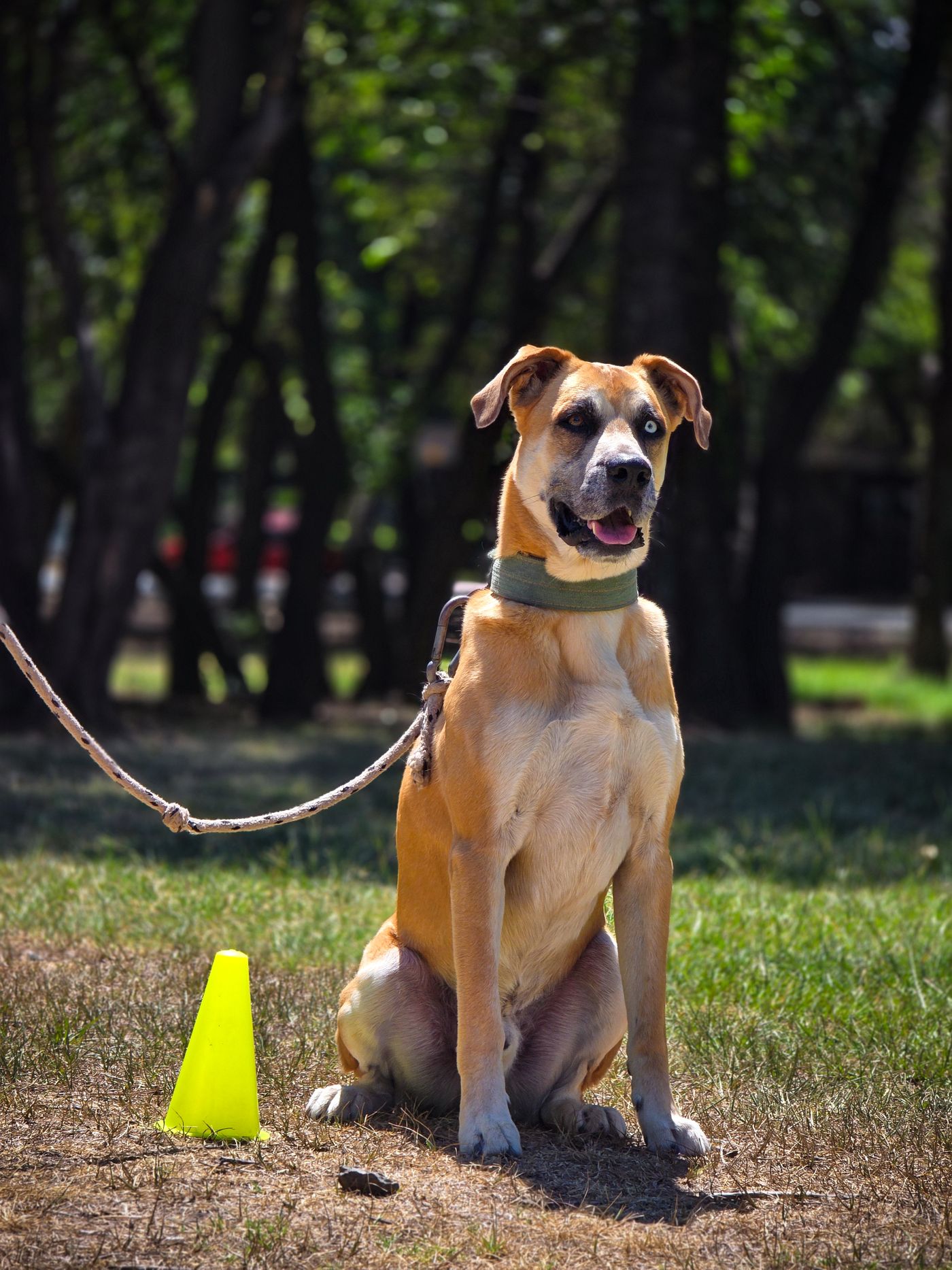
Choose an object that cannot topple easily
Use a broad stable cone or another smooth obstacle with no sharp edges or trapping gaps. Place it on non-slip ground with a generous clear route around it. Begin indoors or in a quiet secure area, away from furniture corners and other dogs. The object should be low enough that you can see your dog throughout. Avoid narrow poles or items that might fall when brushed by a tail or shoulder.
Reward a small part of the curve
Stand beside the obstacle and invite one or two steps around it using a familiar hand target or a gentle lure. Mark and reward that small movement. Gradually connect a wider arc rather than expecting a full circle immediately. Keep your hands at a comfortable height and your pace slow enough for the dog to choose each step. If they cut across the route, make the starting position clearer instead of blocking them with your legs.
Add the cue after the path makes sense
Once the dog can follow the easy curve, introduce a short cue just before the movement. Reduce the amount of hand guidance while still rewarding the route. Practice both directions in separate simple attempts, allowing a reset between them. Some dogs find one turn easier, so do not assume equal fluency immediately. Keep turns broad and stop if the movement appears uncomfortable. This is a gentle coordination game, not a repeated tight-circle workout.
Use the skill in sensible situations
A familiar “around” can help untangle a lead from a tree when there is a clear safe route, but first teach that context at low difficulty. Never direct the dog around an object when you cannot see what lies beyond it. Avoid using the cue beside roads or unstable outdoor structures. A few comfortable arcs followed by another activity keep the game clear without unnecessary repetition or increasing speed for its own sake.


